Culture
Oxford mathematician examined 12 optical corrections in Parthenon and questioned famous explanation
For generations, the story has been told that the Parthenon's builders constructed parts of the temple curved so they would appear straight to the eye. Prof. Allen Gourley from Oxford University examined 12 'optical corrections' attributed to the temple and found they are not supported by evidence or are too small for a viewer to discern, such as a bulge of about 18 mm in the columns. According to him, a curvature of the base could help with rainwater drainage.
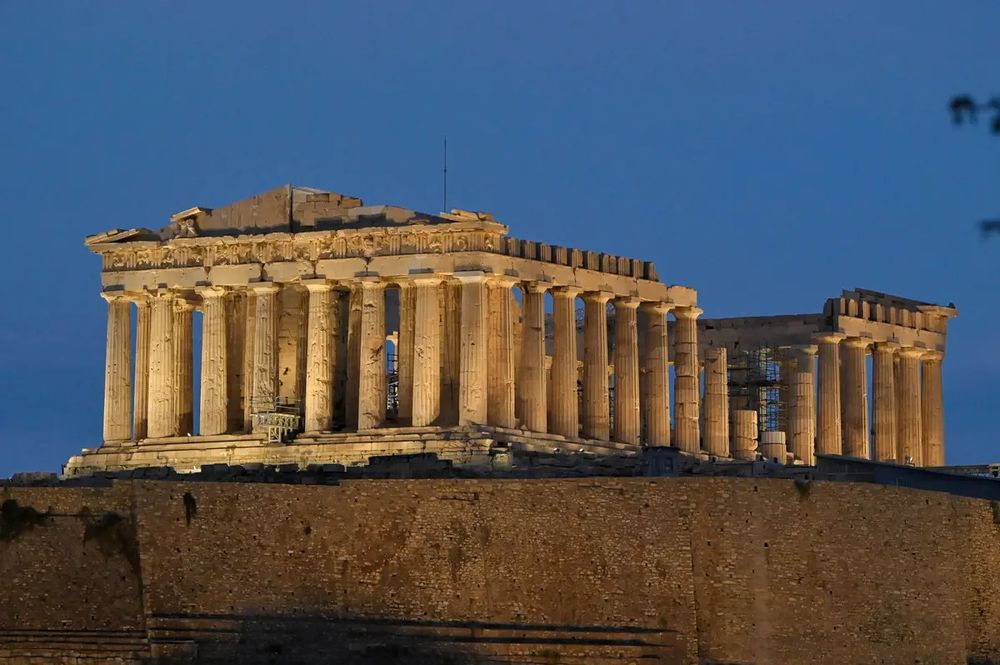
· Source: Walla. Photo as published in the article
Prof. Allen Gourley from Oxford University examined in new research 12 'optical corrections' attributed to the Parthenon temple and found they lack sufficient scientific evidence, contrary to the millennia-old myth that the curved construction was meant to correct visual illusions.
Prof. Allen Gourley from the Institute of Mathematics at Oxford University examined the claim using a combination of geometry, engineering and visual science, in research published this year in the journal Royal Society Open Science. According to the report, he reviewed 12 different 'optical corrections' attributed to the Parthenon and found that they are either not supported by evidence, or they are too small for a person standing in front of the temple to notice their effect.
The base of the columns in the Parthenon is not completely horizontal but rises gently toward the center of the building, in a curve about 6 centimeters high. For generations, the curve has been explained as a correction for the illusion that a long horizontal line appears to sag in the middle, so the architects raised it so it would appear straight. According to Gourley's calculations, there is no convincing scientific basis for the existence of the illusion in the first place, and he proposes that a slight slope at the base could help with rainwater drainage and prevent water accumulation around the columns, or that the curved lines were chosen for architectural and aesthetic reasons alone.
The Parthenon's columns themselves are not completely straight but thicken slightly in the middle, a phenomenon called entasis, in a bulge of only about 18 mm. The prevailing explanation claims that a straight column appears to the eye as if it becomes narrower or concave in the middle, and the Greeks added the bulge to compensate for this. According to Gourley, under normal viewing conditions the difference is too small to be noticeable, and here too no experimental evidence was found that the illusion the bulge is supposed to correct actually occurs.
According to the report, one of the central sources for the myth is the Roman architect and engineer Vitruvius, who wrote about architectural adaptations meant to compensate for visual distortions, even though he lived hundreds of years after the Parthenon's completion in the fifth century B.C. In the 19th century, when researchers began to precisely measure the tiny curves in the building, the idea strengthened that the Greeks had distorted the lines to correct the viewer's vision, and from there the path to textbooks was short.
Gourley is not claiming that the curves are accidental or that the Parthenon is less sophisticated than thought, but rather questioning the story that explains why they are there. According to him, the Parthenon teaches us less about the illusions the Greeks corrected for and more about how easily humans are persuaded to believe perfect stories about mysteries of the ancient world.
Source: Walla