World
Astronomers detected for first time radio signals coming directly from a giant exoplanet
Researchers from Harvard University and University of Oregon detected for the first time, using the MeerKAT radio telescope array in South Africa, radio signals that can be directly attributed to a planet: the gas giant Beta Pictoris b, at a distance of about 63 light-years from Earth. The researchers believe the source of the signals is in the planet's powerful magnetic field, whose strength is estimated at least at about 1.25 kilogauss. They emphasize that there is no indication whatsoever that this is an artificial signal or a message from an extraterrestrial intelligence.
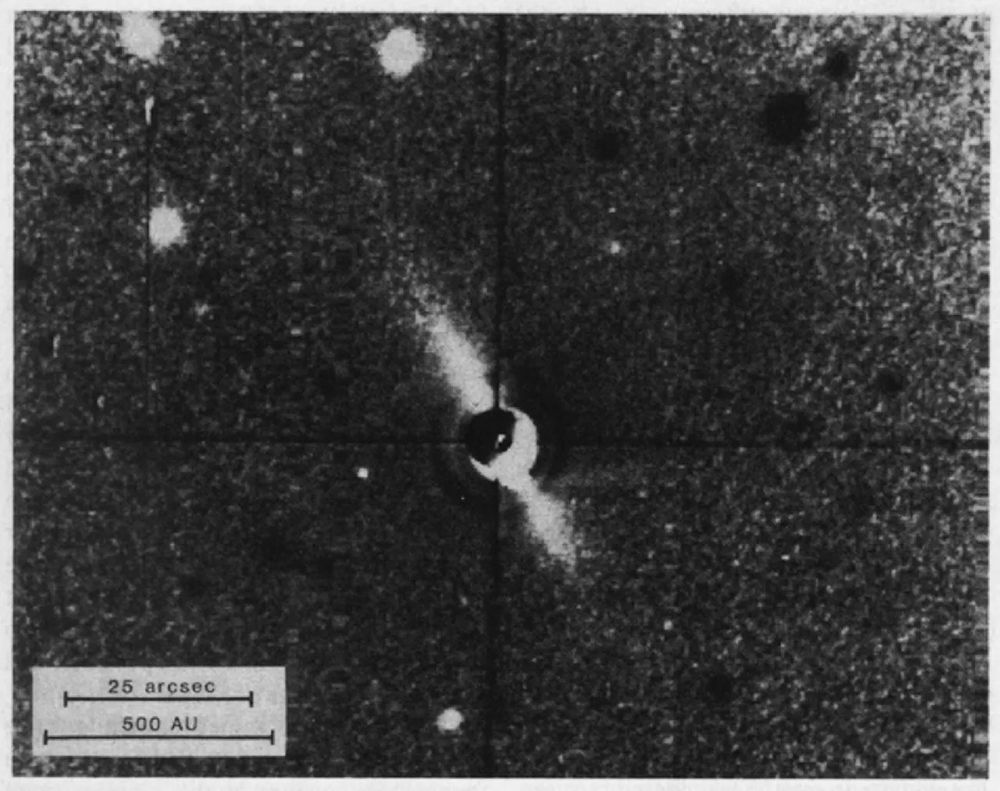
· Source: Srugim. Photo as published in the article
A team of astronomers from Harvard and University of Oregon detected using the MeerKAT radio array radio emissions originating, it is claimed, from the magnetic field of the exoplanet Beta Pictoris b and not from the star it orbits, and from which the strength of its magnetic field can also be estimated.
Astronomers reported an unprecedented achievement in the study of exoplanets: for the first time, radio signals were detected that can be directly and clearly attributed to a distant planet and not to its parent star. The signals come from Beta Pictoris b, a young gas giant located in the Beta Pictoris system, at a distance of about 63 light-years from Earth, and were detected using the MeerKAT radio telescope array in South Africa.
According to the team of researchers from Harvard University and University of Oregon, these are rapid and recurring radio bursts with strong circular polarization, along with continuous radio emission. The researchers believe the source of the signals is in the planet's powerful magnetic field, in a process similar to the one that creates radio emissions associated with the polar aurora in planets in the solar system.
Beta Pictoris b is a gaseous planet whose mass is many times greater than that of Jupiter, extremely young in astronomical terms, and orbits a young star surrounded by an enormous disk of dust and debris. Due to its young age, the planet is still hot and bright relatively, and therefore it is one of the most studied exoplanets also through direct observations.
According to the study, the emission frequencies allow inference about the strength of the planet's magnetic field, and the researchers estimate that this is a field of a strength of at least about 1.25 kilogauss. If the findings are confirmed, this will be the first direct measurement of its kind of magnetic field strength in an exoplanet.
In the past, radio signals were reported from systems in which exoplanets are located, but in those cases it was not possible to determine with certainty whether the source of the signal was in the exoplanet or in the magnetic activity of the star it orbits. In the case of Beta Pictoris b, the researchers claim they succeeded in locating the source of the radiation directly in the planet itself. Despite the great interest in a discovery of this type, the researchers emphasize that there is no indication whatsoever that this is an artificial signal or a message originating from an extraterrestrial intelligence, and the explanation is a natural physical process in which charged particles are accelerated in the planet's magnetic field and emit radio radiation.
Source: Srugim