Investigation
Reservist protest announcements reached Sinwar as intelligence material, according to Hamas seized documents
Public announcements about stopping volunteer reserve service in summer 2023 were collected and analyzed in a secret report sent to Yahya Sinwar. The documents show that Hamas tracked the protest, and that Hamas intelligence even recommended Sinwar wait for the crisis to deepen; they do not prove the protest caused the attack. But Brothers in Arms called on October 7 for immediate mobilization and became, together with additional protest movements, a relief network.
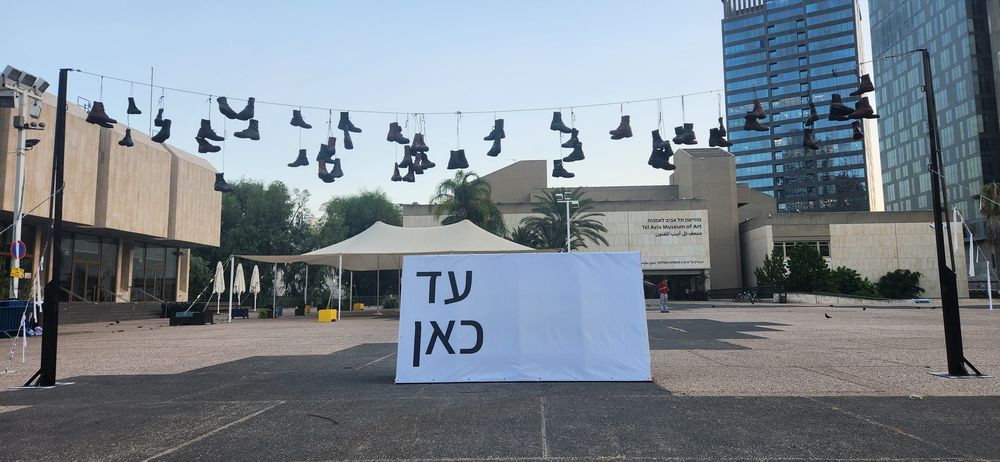
· Photo: Sofiblum, CC BY-SA 4.0, Wikimedia Commons
On Saturday evening, July 22, 2023, representatives of dozens of reserve units gathered at the Air Force Base in Herzliya for a press conference of Brothers in Arms. The announcement was stark: 10,000 reservists would stop volunteering if the legislation advanced (Israel Hayom, July 22, 2023; the movement's announcement, reposted on X). That same evening, according to a review by the Jerusalem Center for Public Affairs, Hamas's al-Aqsa channel broadcast a story about reservists announcing suspension of volunteer service and the impact on IDF readiness. Three days later, on July 25, a secret military intelligence assessment by Hamas was sent to Yahya Sinwar. According to the translation of the document published by the Jerusalem Center, its data section included the Brothers in Arms announcement about approximately 10,000 reservists (Jerusalem Center).
This document, seized in Gaza during the war, does not prove the protest caused the massacre. It proves something more modest and disturbing: the public announcements of summer 2023 were read in Gaza as intelligence material. The article lays out what the documents show, what they do not show, and the position of the protesters themselves, who called for immediate mobilization on October 7.
"When the army is restless and full of doubts, troubles will come from rival rulers. This leads to anarchy in the army and invites defeat."
Sun Tzu, The Art of War, Chapter 3
Sun Tzu's warning in full context
The passage is from Section 16 of Chapter 3 of The Art of War, and in Lionel Giles' classical 1910 English translation it opens with "But when the army is restless and distrustful" (The Art of War in Giles' translation, Project Gutenberg). The section closes a list of factors bringing unrest and distrust within the army, warning that in such a state troubles come from without.
After the section Sun Tzu lists five necessary conditions for victory, and one is particularly relevant to summer 2023: he will win who keeps his army moved by the same spirit of humility at every rank. And in Section 18 appears the familiar maxim: if you know the enemy and know yourself, you need not fear the result of a hundred battles.
The connection between ancient text and the reservist protest is interpretation, not historical fact. But it sharpens a question easy to forget in the heat of internal conflict: how does it look to someone seeking weakness in it. For summer 2023, the question has a documented answer, because Hamas itself left documents.
From a WhatsApp group to a protest movement
Brothers in Arms was founded in January 2023 as a protest movement to stop the legislation planned as part of the judicial overhaul (Globes). According to ynet, it began as a WhatsApp group of a few reservists, initiated by Ron Sharaf, Ail Noe and Ithan Herzel, three reserve paratroopers in the General Staff Reconnaissance Unit, when Justice Minister Yariv Levin introduced his plan (ynet, December 2024). According to the rationale from Reichman University, which granted Noe an honorary doctorate in 2024, the founders' stated goals were preserving Israel as a Jewish, democratic and liberal state, alongside advancing burden-sharing and universal military service (Reichman University rationale).
In those weeks, reservists from various units also published their own letters. By February 26, 250 reserve officers from the IDF's special operations unit signed a letter stating that if the legislation continued without broad consensus, 'we will not continue to volunteer for service in the IDF's special operations' (ynet, February 26, 2023).
On March 5, 37 pilots in Reserve Squadron 69 announced they would not report for drills in protest of the judicial overhaul, but would report for operational activity. According to Maariv, it was actually seven pilots supposed to report for drill, with support from 37 of the 40 squadron members (Maariv, March 5, 2023). Two days later they announced: 'We answer the call of our commanders and will report tomorrow to the unit for fighter debriefing' (ynet, March 7, 2023). On March 19, 450 reserve officers and fighters from the IDF's special operations unit and 200 members of the offensive cyber unit went into effect with announcements they would not report for volunteer reserve service. According to ynet, they were not issued reserve call-up orders for the coming days (ynet, March 19, 2023).
On March 21, the stakes raised. At a press conference of Brothers in Arms leaders, reservist major Ron Sharaf said that if the laws were legislated, he and tens of thousands more would stop volunteering, and said in a shaking voice that 'the army is falling apart.' At that opportunity he announced: 'Today, we will begin actively enrolling all reserve volunteers.' (ynet, March 21, 2023). A week later, with legislation suspended for talks, a retired senior Air Force officer and protest leader said: 'It's clear we're returning to squadrons, returning to training.' Brothers in Arms leaders announced an end to the protest, but clarified that 'the protest will resume immediately if it becomes clear that time given for talks is being used cynically' (Walla, March 28, 2023).
July 2023: Volunteering becomes a pressure tool
The second round was sharper. On July 11, after approval of canceling the reasonableness clause on first reading, 300 members of the IDF's offensive cyber unit, Shin Bet and Mossad announced they were immediately stopping volunteering (ynet, July 11, 2023). On July 19, hundreds of reservists signed a joint declaration at a Brothers in Arms event outside the Tel Aviv Museum stating they would not report for IDF service until the overhaul was halted (Walla, July 19, 2023). On July 21, 1,142 active Air Force reservists, including more than 400 pilots, published a letter saying they would halt their volunteering if the reasonableness clause law was approved the following week (Times of Israel, July 21, 2023).
At the press conference in Herzliya the next day, one of the speakers, Lt. Col. Navo Araz, phrased the position: 'Not insubordination but rather a halt to volunteer reserve service' (Israel Hayom, July 22, 2023). That day the movement set up at a checkpoint of the march to Jerusalem a petition in the form of a personal letter, a 'declaration of suspension of volunteering,' which read: 'This declaration was written in great pain, and out of my moral and conscience duty' (ynet, July 22, 2023). On July 24, the Knesset approved the reasonableness clause reduction law on second and third reading, with a majority of 64 supporters and no opponents, after the opposition boycotted the vote (Knesset channel, July 24, 2023).
The announcements did not stop with passage of the law. On July 31, more than 60 graduates of the IDF intelligence unit's 'Habatzelet' program announced suspension of their volunteering, and the IDF Chief of Staff called in phone calls held two days prior with reservists to return to volunteering (ynet, July 31, 2023).
Late summer: The announcements continue
The announcements also continued in late summer. On September 3, the Brothers in Arms account on X posted an announcement opening with the words 'The people is torn, the army is falling apart' and called to protest at a political event in Raanana the next day (Brothers in Arms post on X). On September 8, journalist Ben Caspit published a statement attributed to 460 members of offensive cyber reserves from IDF intelligence, Shin Bet and Mossad, in which it stated: 'We stopped volunteering for reserves in July' (Ben Caspit's post on X). The announcement is not from Brothers in Arms, the signers are not identified by name, and the number is self-reported and unverified.
On October 2, Channel 13 reported that Air Force Commander Maj. Gen. Tomer Bar set October 17 as the final deadline for reserve pilots who stopped volunteering to return, ahead of a major joint exercise with other air forces. The IDF confirmed that Bar instructed talks with reservists to map the force's readiness and return them to service (Times of Israel citing Channel 13). Five days later, ten days before the set deadline, the war broke out.
Suspension of volunteering, insubordination and what lies between
In public debate, the word 'insubordination' described different things: conditional threats, declarations, suspension of volunteering and actual non-reporting. Many signers were volunteers, whose service depended on their consent. Prof. Kobi Michael from the National Security Research Institute explained that in this model call-up orders are issued after volunteers coordinate with their commanders about service days. The protesters, he wrote, announced they would refuse only to volunteer, not refuse to serve if called for operational reasons; Michael himself believed that in practice it was a refusal to serve (INSS, Perspective on 1710, April 18, 2023).
The IDF itself explained in response to a freedom of information request, from December 29, 2025, that volunteering for reserves is an individual's decision to serve even though not obligated, and that the volunteer is not required to provide a reason for stopping. According to the response, declarations of canceling volunteering in a protest context were handled by commanders in units, and 'there is no documentation of the reasons for suspension of volunteering by reserve personnel' (IDF response to freedom of information request, December 2025). The meaning is straightforward: there is no official source allowing calculation of how many stopped serving because of the protest, and signature numbers are not absence numbers.
The distinction does not cancel the security question. On August 11, the Air Force commander, in a conversation with about 60 officers and pilots, said there was limited impact on readiness, mainly in the Air Force, and the IDF is currently capable of war, but the impact 'is growing deeper as time passes.' In that conversation he noted, according to reports, that using the Air Force to influence political issues and policy is prohibited (ynet, August 11, 2023).
Brothers in Arms: The position in their words
Fair to present the logic of the protesters as they framed it. On the official website, the movement defines itself as a 'civic-social movement,' writing that it began operating in January 2023, right after the Justice Minister announced his intention to lead a judicial overhaul (Brothers in Arms official website). At the July 22, 2023 press conference, members stated: 'Changes in the judicial system are made with broad consensus, not forcibly' (mako, July 23, 2023).
Kobi Michael and Gabi Siboni from the National Security Research Institute, who leveled sharp criticism at the move, also presented the officers' argument: it is refusal to volunteer and not refusal to obey a call-up order, and the legislation violates their contract with the state, under which they defend it on condition it preserves what they see as democratic values (INSS, Perspective on 1760, September 5, 2023). In a July petition it also stated: 'A civil-military bond exists only in a democracy' (ynet, July 22, 2023).
In a ynet interview in December 2024, Ail Noe said: 'Brothers in Arms never called for insubordination,' and explained: 'We talked about suspension of volunteering because we felt that one of the foundation anchors of the state, democracy, was in danger.' He rejected the claim that the protest damaged IDF readiness: 'Any attempt to try to blame the protest for damaging IDF readiness is false.' Ron Sharaf described his volunteering suspension as 'the hardest decision I made in my life on a personal level' (ynet, December 20, 2024).
To the claim that the protest contributed to the invasion, Amri Ronen, a movement leader, replied in ynet's '120 Plus One' podcast: 'There is no connection' (ynet, August 2024). In December 2025, Noe claimed in a podcast by Miki Levin at Maariv that according to Hamas documents, the organization's analysts recommended not attacking, and understood that 'all those insubordinate people would return like a missile to the army.' According to him, 'that's exactly what happened in practice, everyone mobilized' (Maariv, December 2025). The document itself did anticipate that protesters would return to service during escalation, but spoke of some, not all.
Warnings from the security establishment
Warnings also came loudly from IDF leadership. On March 8, the Chief of Staff, Maj. Gen. Herzi Halevi, told dozens of reserve commanders in a meeting that 'insubordination is a red line.' At that meeting he objected to statements unbecoming toward reservists and said: 'Saying traitors should not be said. There are no such people here' (Maariv, March 8, 2023).
On March 21, the National Security Research Institute published a strategic warning, the first of its kind it published. It stated that significant damage had already been done to willingness to volunteer, cohesion and mutual trust within teams and between them and their commanders, and that Israel's enemies draw encouragement from the internal rift and might be tempted as a result to dangerous actions (INSS Strategic Alert). In the background document it stated that the reservist protest was unprecedented even compared to the period after the Yom Kippur War, and that Hezbollah leader Hassan Nasrallah claimed publicly that Israel was on the brink of civil war (INSS background document, March 2023).
In July, when the announcements reached their peak, the security establishment spoke in two voices that are not contradictory. On July 23, IDF spokesman Lt. Col. Daniel Hagari said one must distinguish between declarations of non-reporting and insubordination in practice, which they had not yet encountered, and added: 'Our position is clear: non-reporting harms the IDF.' He said 'right now, the IDF is capable of war,' 'there is no rebellion here' and that those declaring are 'our best people.' And in that interview: 'The enemies are looking at what is said, so one must act with national responsibility' (mako, July 23, 2023).
That morning the Chief of Staff published a special letter to IDF personnel: 'We have no right to refuse an order or call-up.' He called on reservists to separate civic protest from security service and report, and wrote that when controversy spills into army ranks, 'a ground fighter might mistakenly think an Air Force pilot won't help him because of that controversy, an Air Force pilot might mistakenly think he can avoid preparation and maintaining war readiness, when in fact we might need him soon' (ynet, July 23, 2023).
In a conversation with forum heads of flight and operational units, reported July 28, the Air Force commander said: 'It is possible that at such a time they will try to test the boundaries of our decree, our cohesion and alertness' (ynet, July 28, 2023). That day ynet reported that IDF intelligence assesses that enemies are identifying a historic opportunity to change the strategic situation, that Iran and Hezbollah are closely tracking the crisis in the reserves network, and that they would prefer to sit on the fence (ynet, July 28, 2023).
IDF intelligence research division also wrote warnings, in letters published only after the war began. According to a Haaretz report cited by Walla, division head Lt. Col. Amit Saer warned in July that escalation of the crisis increases the likelihood of escalation, and set that the immediate danger is in the Lebanese arena. In his letters he wrote: 'We see hesitation on whether to sit on the fence and let Israel continue weakening itself or take initiatives and sharpen its situation even more' (Walla citing Haaretz, November 20, 2023). According to Yedioth Ahronoth, the warnings focused on Iran and Hezbollah, although the IDF said they dealt with enemies in all arenas, and the position of the IDF, Shin Bet and the Coordinator of Government Activities was uniform: Hamas is deterred and does not want war. In a situation assessment ahead of the High Holidays it was set: 'To our understanding, Sinwar has no interest in broad confrontation' (Yedioth Ahronoth, May 24, 2024).
On September 11, at a gathering marking 50 years of the Yom Kippur War, Halevi sent a message to enemies: 'Our enemy might be tempted to see advantage in the multi-front threat against us, but they should know that when Israel is threatened, it knows how to mobilize all its resources and set aside controversy' (ynet, September 11, 2023). Common to these warnings was the assessment that what was said in Israel aloud was also heard beyond the border. Seized documents show that at least in Gaza, it was indeed heard and analyzed.
Hamas read the Israeli media
In June 2025, the Intelligence and Terrorism Information Center published research by Dr. Yigal Shiri and Dr. Haim Isserowitz, based on seized documents captured in Gaza (Research Center, June 12, 2025). The picture emerging from it is much broader than Brothers in Arms. On November 27, 2022, during coalition negotiations, Hamas military intelligence sent Sinwar an assessment that the incoming government would strengthen 'structural instability' in Israel and lead to 'escalation of confrontation' between right and center-left. On January 14, 2023, Ismail Haniyeh said before the Hamas executive committee reviewing the report: 'The contradictory and conflicting statements we hear and the demonstrations show that the entity is in an unprecedented internal state.'
On March 6, in a letter to Haniyeh ahead of his visit to Iran, Sinwar wrote, in the Jerusalem Center's translation: 'The enemy's internal situation, its divisions, conflicts and crises, must occupy a place, even if small and focused, in our attention' (Jerusalem Center review). On April 4, a member of the political bureau living in Beirut, Mohammad Nazzal, told him: 'Israel's internal division is the greatest instrument of destruction that can destroy Israel.' Sinwar agreed, noting that the quiet in the protest was temporary only and was a 'deep crisis' (Research Center).
The central document, from July 25, was sent to Sinwar by a figure called 'Yasser' from the military intelligence and, according to the Information Center, likely head of Hamas military intelligence, Mohammad Odeh. According to the research, the data in it were apparently based on Israeli media publications: 161 pilots, soldiers and officers in the Air Force who announced suspension of reserve service, 1,142 Air Force reservists who threatened to stop volunteering if legislation passed, and 1,500 soldiers and officers from military intelligence who expressed willingness to refuse to serve, of which 1,400 from Unit 8200 (Research Center, pages 7-8).
The number 1,142 is exactly the number of signers of an Air Force personnel letter published in Israel four days earlier. In the full translation of the document published by the Jerusalem Center appears in the data section also Brothers in Arms, presented as one protest organization, with the announcement about approximately 10,000 reservists who would not report for service if the judicial changes were completed. Beside it were listed more than 420 fighters from Naval Commando 13 and 250 fighters from the General Staff Reconnaissance Unit who announced suspension of volunteering or intent to suspend (Jerusalem Center review).
The document also included statements by the Chief of Staff and Air Force commander, statements by senior coalition and opposition officials, and a poll showing that approximately 54 percent of the public opposed the decision of some reserve personnel to stop volunteering, compared to 36 percent who supported it. In the interpretation section it stated that the pilots are the most influential in the crisis because 'their number is small relative to other specialties and their quality is of utmost importance' (Research Center, pages 9-10). In other words: the open Israeli discourse, including warnings by the IDF itself, served as raw material.
Hamas television also tracked it. According to the Jerusalem Center review, al-Aqsa channel broadcast on March 6, 2023, a story about Air Force insubordination that included clips from a Channel 13 report; on July 9 it broadcast a report on the protest that mixed a Channel 13 report clip with Arabic subtitles; and on the evening of July 22, an interviewee on the channel said 10,000 reservists from all the other corps had already signed (Jerusalem Center review).
According to the New York Times, in protocols of ten secret planning meetings of a small group of Hamas leaders, found on a computer in their underground headquarters in Khan Yunis, Israel's internal situation was listed among the reasons to launch the operation, in arguments prepared against Hezbollah; according to the newspaper, apparently reference to the overhaul crisis. According to those protocols, Hamas planned the attack as early as fall 2022 and postponed it while trying to persuade Iran and Hezbollah to join (New York Times, reposted in Seattle Times).
The caveats within the document itself
Whoever seeks to turn the documents into an indictment must also read the assessment section, which stated: 'The number of soldiers and officers refusing has not yet significantly affected the operational readiness of the army.' The writers assessed that readiness would not be damaged without refusal of more than half of reserve pilots, and that refusal of a quarter of them would constitute significant damage to ability to handle multi-front confrontation. And in section 7 of the assessment they wrote: 'In the event of escalation of any front against the enemy, some of the soldiers and officers will regret their refusal and return to military service' (Research Center, pages 11-12).
The recommendations were in that spirit. The first: avoid military confrontation and let the crisis deepen. The second: coordinate with other organizations psychological warfare and 'focus on streaming information that will ignite the internal situation.' The writers even warned that Israel would be 'more sensitive' to initiated action and therefore expected to respond with force (Research Center, pages 12-14). According to the research, Sinwar continued preparations and ordered the attack while the crisis was still underway (Israel Hayom, June 12, 2025). Dr. Haim Isserowitz, one of the research authors, told ynet about the mention of Brothers in Arms: 'Hamas took a line and a half of quote from Israeli media, they did not interview anyone from Brothers in Arms' (ynet, August 26, 2025).
The interpretations of the weight of all this are far apart. According to ynet, an intelligence investigation published by the IDF in February 2025 found that the judicial overhaul and protest against it were not a consideration for Hamas in the timing of the invasion, and that Hamas had intended to carry out the 'Jericho Wall' plan in the fall holidays 2022 and Passover 2023 (ynet, February 27, 2025). In a summary of IDF intelligence investigations presented to journalists it stated that before the war intelligence assessed that 2023 held potential for uncoordinated multi-front escalation due to perceived weakness stemming from internal political conflicts, but no evidence was found that the overhaul rift contributed to attack planning, and in May 2023 Hamas chose October 7 as the date (Times of Israel, February 27, 2025).
By contrast, Lt. Col. Yonatan Dachach-Halevi from the Jerusalem Center assesses that expressions of non-reporting in August and September 2023 were included with high probability in the situation assessment of Hamas leadership, and constituted a substantial contributing factor in setting the attack timing (Jerusalem Center review). This is a researcher's assessment. To turn it into a finding requires documentation connecting the gathered information to the operational decision. The expert committee headed by Maj. Gen. Sami Turgeman, whose findings were presented by Chief of Staff Ayal Zamir in November 2025, wrote that throughout 2023 senior IDF officials warned that enemies were identifying internal weakness damaging deterrence, but the IDF did not improve its readiness or adjust its deployment (ynetnews, November 10, 2025).
October 7: The call to mobilize
On the morning of October 7, 2023, Brothers in Arms published a short announcement: 'Brothers in Arms call on everyone needed to mobilize to defend Israel without hesitation and immediately. Right now the most important thing is the security of the citizens of the state.' Kaplan Force canceled the protest planned for that evening (Israel Hayom, October 7, 2023). Ail Noe told Globes that the organization became from a protest movement to a civic movement 'with an initial purpose on Saturday at noon. At that moment we understood that the protest was over and our mission right now is to help the IDF win and help the families of the Envelope.' According to him, 15,000 volunteers operated, a forward command center was established at Beit Kama junction and more than 2,500 families were rescued (Globes, November 11, 2023).
According to Times of Israel, approximately 15,000 Israelis answered the call of protest movements that became overnight a relief network, operating from Tel Aviv Expo from the day after the massacre and evacuating 3,000 civilians from Envelope communities, 200 of them under fire (Times of Israel, October 22, 2023). Amri Ronen described that day this way: 'On October 7, everyone around me, everyone I know, jumped first, without an order, arrived where they needed to arrive when they needed to' (ynet, August 2024).
The mobilization was broader than one movement. According to an analysis by Rabbi Kinon in the Jerusalem Post, though until October 6 thousands of reservists announced they would not report, on October 8, 20 to 30 percent more reservists than expected numbers arrived at bases (Jerusalem Post, May 4, 2025). The Air Force commander said in July 2024, at a ceremony concluding officer training courses at Ovda Base: 'The Air Force entered the events of that cursed Saturday without an operational readiness problem. We showed this multi-front difficult war united and cohesive, despite the protest, and since we have not landed' (ynet, July 17, 2024).
Also Chagai Segal, a sharp critic of the reservist protest, wrote in primary source that after checking with pilots and senior commanders, 'Maj. Gen. Bar and the IDF spokesman speak truth,' and delay in air support to the Envelope did not stem from readiness problems. Segal himself believed that mobilization does not prove there were no insubordinates, and called this argument 'evidence on chicken legs' (Makor Rishon, August 3, 2024). Also in the sense of solidarity a sharp change was recorded: according to the Israel Democracy Institute's Democracy Index, the rating Jews gave to solidarity in Israeli society dropped to a low of 4.4 on a scale of 1 to 10 in June 2023, at the height of the protest, jumped to 7.2 in October and fell slightly to 6.7 in December (Israel Democracy Institute).
Mobilization does not cancel criticism of summer strategy, and criticism does not cancel mobilization. Serious research must hold both: that same movement used the service question to pressure the government, and in the hour of truth called for mobilization and acted to help.
The lesson: The enemy reads Hebrew
Hamas documents do not make the protesters traitors; already in March 2023 the Chief of Staff said there were no such people. They teach something simpler: letters, press conferences and media reports about the IDF's capability were read and analyzed in Gaza, and intelligence estimated that Tehran and Beirut also followed closely. A public announcement about military capability is also a message to the enemy, whether intended or not.
This is the solid criticism of Brothers in Arms' strategy and of the reserve protest groups: not the protest itself, but the choice to turn the continuation of volunteering, and the numbers behind it, into a public pressure tool. The announcement of 10,000 was meant to pressure decision-makers, and it reached Sinwar too. The phrase 'the army is falling apart' was meant to illustrate danger. In the enemy's eye it could have read as confirmation that danger had already materialized, even when the IDF itself said it was ready for war.
The lesson is not directed at one side alone. Hamas intelligence recommended leaking information that would ignite the internal situation: the enemy not only read Israeli debate, but sought to deepen it. Every voice presenting the other side as existential threat provides him raw material.
In the movement itself they said in December 2024 that calling to stop volunteering is no longer part of their toolkit. When asked if they would call for it again, Ron Sharaf said if needed, certainly they would return to the streets, and Ail Noe added: 'What was right for 2023 does not fit the new reality. These calls are not in our arsenal today' (ynet, December 20, 2024). The public also marked a boundary: in an National Security Research Institute survey from September 2023, among a representative sample of the Jewish population, 55 percent at that time opposed reservists declaring suspension of volunteering. In a scenario in which a law would be legislated exempting Haredim from service, the rate of opponents drops to 44 percent, compared to 37.5 percent who said they would support them (INSS, September 2023 survey).
Sun Tzu wrote that one who knows the enemy and knows himself need not fear the outcome of a hundred battles. Hamas, it turns out, learned to know Israel also through its media. The lesson for Israel is to know itself also through his eyes: to preserve the right to dispute, and to remember that dispute about the army is also read in Gaza. Halevi framed the answer less than four weeks before the attack: when Israel is threatened, it knows to set aside disputes. On October 7, at least on the question of mobilization, it did exactly that.
An investigation by the Israel News desk. The main report it draws on: מרכז המידע למודיעין ולטרור