Opinion
39 versus 48: the manipulative framing of the Israelim page
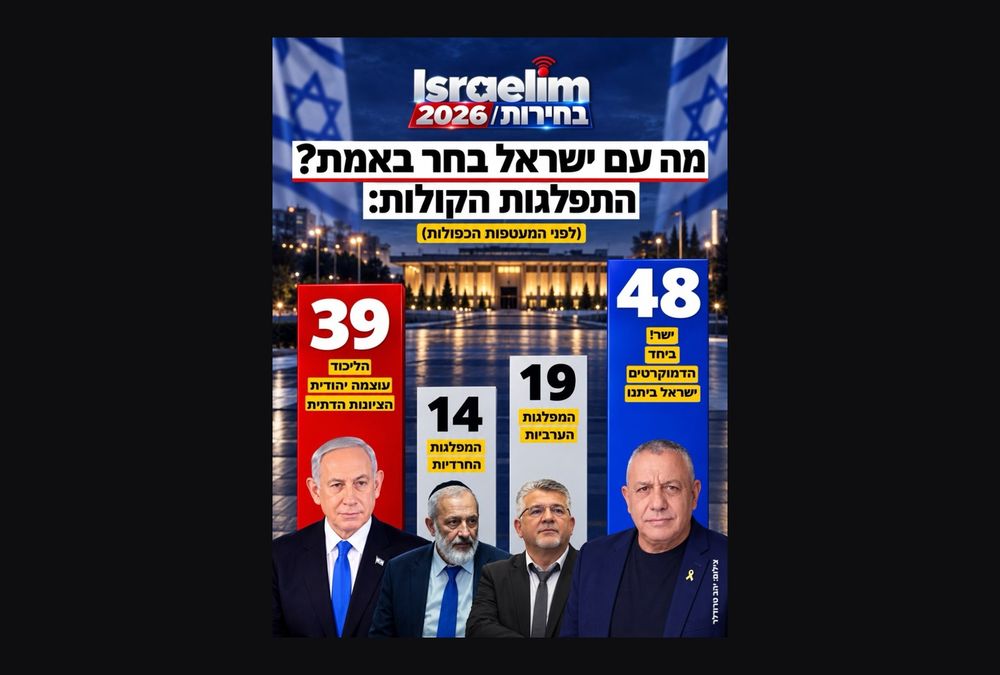
The graphic gives three right-wing parties 39 seats and Eisenkot's bloc 48, listing the ultra-Orthodox parties separately. The original caption explicitly puts Netanyahu's bloc, including those parties, at 53. In our view, this visual split creates a misleading first impression. This opinion column concerns the framing; the figures are those in the post before double-envelope ballots were counted, not final results. The Israelim graphic is reproduced for criticism, with its original markings retained.
· Source: Israelim. Graphic reproduced for criticism from the Israelim page; original markings retained.
Opinion: Separating the ultra-Orthodox parties in the Israelim page's election graphic creates a misleading picture in our view, although the original caption explicitly says Netanyahu's bloc, including those parties, has 53 seats.
The graphic published on October 28 shows 39 seats for Likud, Otzma Yehudit and Religious Zionism, against 48 for the parties in Eisenkot's bloc. The ultra-Orthodox parties' 14 seats appear in a separate column, and the Arab parties are shown with 19. These are the figures presented in the post, which was labeled as preceding the double-envelope ballot count. They are neither final results nor a live update today.
Our criticism concerns the graphic's design. When one camp is presented as a bloc and the other is split, the first glance tells a different political story from the full tally. Eisenkot's column is taller than the column for the three right-wing parties, but that comparison excludes the ultra-Orthodox parties from the bloc in which the caption counts them.
This must be stated explicitly: the same post's caption puts Netanyahu's bloc, together with the ultra-Orthodox parties, at 53 seats. That number is not missing from the entire publication. The gap between the caption and the graphic is precisely the issue: a reader who sees only the image gets a different impression from someone who also reads the explanation.
In our view, this is manipulative framing. Applying the same principle to each bloc would let readers compare the camps, instead of comparing an entire bloc with only part of another. The alliances and their political significance can be debated, but the grouping should be clear in the image itself.
The israelim.il profile describes itself as a news and current-affairs page from Erev Tov. This criticism addresses the post we examined and its presentation. The post does not establish an intention to foment a revolt, and we have no evidence that Guy Pines personally edited the graphic or ordered its publication.
An opinion column by the Israel News desk. The report it draws on: הישראלים