World
Archaeologists uncovered in heart of Paris a wall possibly from fortifications of Gallic Lutetia
In excavations a short distance from Notre-Dame Cathedral, a stone and wood wall about 20 meters long was uncovered, possibly part of the fortifications of Lutetia, the Gallic settlement from which Paris grew. Preliminary carbon-14 tests on wood fragments pointed to a date range between 200 and 10 B.C., which includes the Battle of Alesia in 52 B.C. during Julius Caesar's Gallic Wars. The French Culture Ministry defined it as significant progress but emphasized that the conclusion is still uncertain.
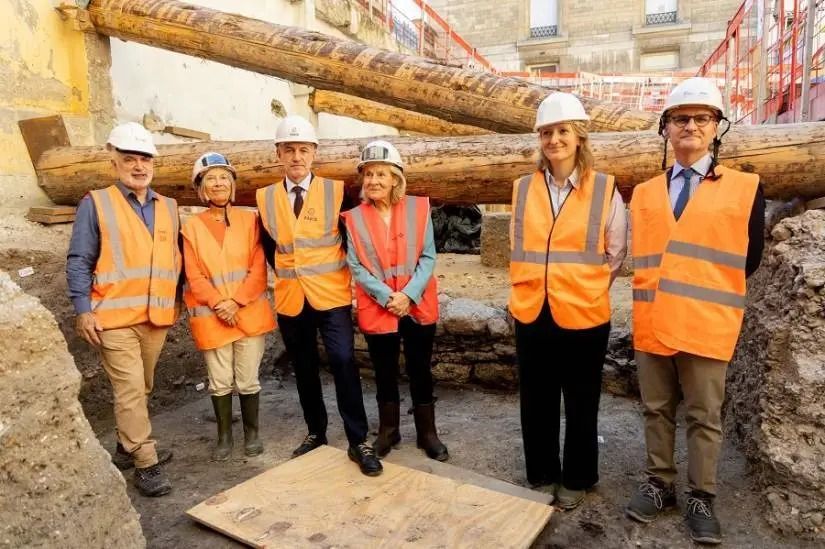
· Source: Srugim. Photo as published in the article
Archaeologists who uncovered in the courtyards of the Hôtel-Dieu hospital on Île de la Cité in Paris found a stone and wood wall about 20 meters long that may belong to the fortifications of Lutetia, the ancient Gallic settlement from which the city grew.
The excavations are being conducted in the courtyards of the Hôtel-Dieu hospital on Île de la Cité, a short distance from Notre-Dame Cathedral. Archaeologists uncovered a massive wall built from stone and wood, stretching about 20 meters long and found at a depth of about four meters. Its construction method is typical of Gallic fortifications from the late Iron Age, and the wall may be part of the fortifications of Lutetia, the ancient settlement of the Parisian Gallic tribe from which Paris later grew.
The question of where exactly Gallic Lutetia was located has occupied researchers for years. Tradition pointed to Île de la Cité, but the absence of significant Gallic finds on the island led other researchers to suggest that the center of the ancient settlement was located in the Nanterre area, west of Paris. Preliminary carbon-14 tests conducted on wood fragments pointed to a date range between 200 and 10 B.C., a range that also includes 52 B.C., when the Battle of Alesia took place as part of Julius Caesar's Gallic Wars.
According to the report, in his writings Caesar described how the Gauls set their settlement on fire before the confrontation with the Roman army, but researchers emphasize that at this stage it is impossible to determine whether the burn marks found on the wall are specifically related to that historical event. Around the wall were found charred seeds, remains of a burned wood structure and a Gallic spearhead, and behind it was uncovered a large platform of sand and gravel preserved to a thickness of nearly two meters. Researchers are examining whether the wall was part of a fortified settlement system, whether it also served as a retaining wall, and what its relationship was to the banks of the Seine.
The French Culture Ministry defined the find as significant progress in researching Paris's origins, but emphasized that the final conclusion is still not certain and additional tests are needed to precisely determine when the wall was built, its function and when it was destroyed. If the tests confirm that it is part of the Gallic settlement's wall, it could be the strongest direct archaeological evidence to date connecting Île de la Cité to the Lutetia that Julius Caesar described. Due to its fragile condition, the wall is not expected to remain in place, but authorities plan to document it in photogrammetry and a three-dimensional model, prepare a cast of part of it and incorporate original stones in a reconstruction to be displayed in a museum in Paris.
Source: Srugim