Opinion
The Five Change Bloc Leaders Agreed How to Win, Not Where to Lead the Country
The principles document signed by Eisenkot, Bennett, Golan, Liberman and Lapid deals mainly with voting percentages, spokespersons and commitments not to attack each other. Foundational lines for the next government, from a constitution to equality of burden, remained as titles that a working group would still 'formulate', and the Change Bloc candidate for prime minister was not determined. The document acknowledges 'ideological disagreements' and states that 'establishing a government of change and reconstruction, Zionist and statist, is our shared overarching goal', and that is what unites them.
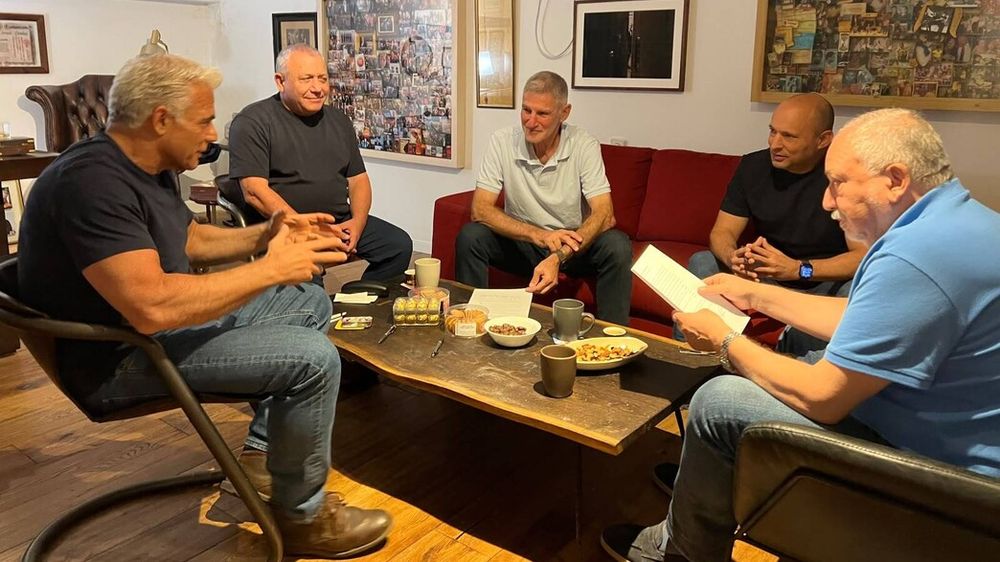
· Photo: Lihi'a Lapid
The principles document signed Saturday night by Eisenkot, Bennett, Golan, Liberman and Lapid deals mainly with voting percentages, spokespersons and an internal weapons truce, but a month before elections it leaves the voter without a clear answer to three decisive questions: who will lead, with whom, and where.
Saturday night, Sept. 26, 2026, Gadi Eisenkot, Naftali Bennett, Yair Golan and Avigdor Liberman gathered at the home of opposition leader Yair Lapid in Tel Aviv. According to N12, the previous meeting of the Change Bloc leaders forum was held in November 2025. At the end of the current meeting, the five released a joint photograph and a document titled 'Principles Document of Leaders of the Correction and Hope Parties'. Such a document, a month before elections on Oct. 27, is supposed to answer, first and foremost, one question: what do the signatories intend to do with the country if they win.
It must be said frankly: the document is not empty. The five committed to doing everything, 'each in his domain, in order to increase the number of voters', to establish a working group to increase voter turnout and a joint spokespersons group, and to work together to establish a government after elections. Regarding group b, it is written that it 'will formulate the foundational lines for the next government', including equality of burden, a state commission of inquiry into the Oct. 7 massacre, limiting the prime minister's term, a constitution and a 100-day action plan for the first days of government. These are weighty matters, and their inclusion in the foundational lines is an explicit direction, even without elaboration.
But a title is not a plan. The verb the signatories chose is 'will formulate', in future tense: according to the document's wording, the foundational lines have not yet been formulated when the five signed, and the work was handed to a group that the document sets to be established only within 48 hours. A constitution appears as a single word without saying which one, and equality of burden appears without saying how and when. As for the partnership itself, the document has clear time anchors: the groups will be established 'within 48 hours', the quiet between the partners will take effect 'from today until the establishment of government', and joint action to establish government will begin 'immediately after elections'. The group supposed to formulate the foundational lines has no deadline for submitting its work. Yair Golan wrote on X before the meeting that 'we need to agree on the foundational lines of the next government', and by the end of the evening, that agreement too was handed over to a working group that would still 'formulate' it.
A month before elections, the voter is entitled, first of all, to know which of the five will stand at the head of the camp, and the document is silent. According to ynet, they agreed among themselves to deal with the issue only after elections, and according to Channel 7 there is not even a clause in the document that will set how it will be decided who will stand at the head of the Bloc. This despite the fact that according to N12, Eisenkot himself criticized sharply, a week and a half before the meeting in an interview on Channel 2, Bennett and Liberman for not declaring rules for determining an agreed candidate. There is an explanation for the postponement from some of the partners: Liberman said on 103FM, as N12 reported against the backdrop of the clash with Eisenkot, that 'we need to stop talking in terms of him first, him second', and Bennett wrote after the meeting that 'everyone understood the magnitude of the moment, and set aside all personal considerations'. It is possible to read the postponement itself as setting personal considerations aside, as avoiding an internal struggle a month before the ballot. But the result is that precisely the most personal question, who will stand at the head, was postponed after elections, and whoever votes for the Bloc is asked to sign a blank check.
The second question is with whom government will be established. According to i24NEWS, the document does not address relying on Arab parties, even though according to ynet Liberman sent to his partners in the days before the meeting a message that Arab parties, including Ra'am, are not under consideration from his perspective, out of suspicion that Eisenkot will establish government with Ra'am's support or its abstention. Yoav Seglaowitz of Ra'am wrote in response on X: 'Eisenkot will not have a government without Ra'am'. And according to a flash on the 'Every Moment' website, the Democratic Party clarified the next day, regarding Golan's words on including Arabs, that 'the subject did not come up at all at the meeting held last night'. This disagreement was not resolved in the document, and according to the Democratic Party's clarification the subject of including Arabs did not even come up at the meeting.
And there are questions the document does not even attempt to address. There is no position in it on security, on Iran or on Gaza, there is no word in it about economy or cost of living, and the Oct. 7 massacre is mentioned in it only as a subject for a commission of inquiry, not as a starting point for security policy. Before the meeting Golan wrote that the public 'rightfully demands from us that we present a shared vision and a governing alternative', and Eisenkot said on 'Meet the Press' that 'the essence of the meeting is how we win elections'. By Eisenkot's measure the meeting achieved its goal; by the measure Golan set, it did not pass.
On the question what all this says about the five, the document itself answers: 'Even though there are ideological disagreements among us', they wrote, 'establishing a government of change and reconstruction, Zionist and statist, is our shared overarching goal'. What holds this camp together is the aspiration to establish government, not a shared conception of what to do with it. Unlike the foundational lines, the second clause is worded with care: 'From today until the establishment of government, no one among us or anyone acting on our behalf will attack a partner party in the Bloc or the one standing at its head'. This is a clause that regulates relations among the signatories, not what the citizen will receive from them. They committed 'to each other and to the citizens of Israel', but the commitment to each other they formulated down to the last word, and to citizens they left titles. The voter deserves to know not only that they are together, but why.
An opinion column by the Israel News desk. The report it draws on: ynet